
How Hornet Built a Creative Production Pipeline Across On-Premises and AWS with Resilio
When cloud render farms started overwhelming on-premises storage and remote artists faced 45-minute file open times, Hornet replaced manual workarounds with continuous synchronization—and turned distributed teams into a competitive advantage.
~4M Files
Continuously synchronized between on-prem and AWS
45 min → 2 min
Cloud-based file open times
100–200 Nodes
AWS render farm scaled on demand
Hornet is an award-winning production company specializing in commercial animation, live action, and design-driven storytelling. Headquartered in New York City's Soho neighborhood, Hornet collaborates with top brands, agencies, and creative partners to produce high-end content across advertising, entertainment, and emerging media.



The Challenge
“Anytime we tried to use cloud machines with our on-prem storage, there was massive lag. A file that would take two minutes to open locally could take up to 45 minutes. That just wasn't sustainable.”— Gareth Porter, Head of Pipeline at Hornet
The Solution
Choosing Hybrid Infrastructure Instead of All-Cloud or All-On-Premises
Hornet evaluated both ends of the spectrum. Fully cloud-based workflows introduced unacceptable latency in file access. Staying entirely on-premises constrained the studio's ability to scale rendering and onboard global talent. Neither extreme worked for a studio operating on advertising-industry deadlines. Platforms like Microsoft Azure and Amazon Web Services each offer cloud-native approaches, but a pure lift-and-shift to any single provider would have sacrificed the on-premises performance that local artists depended on.
The team made a deliberate architectural decision: combine the strengths of both environments. On-premises storage would continue to anchor local production. AWS would provide elastic rendering and virtual workstations for cloud and remote workflows. A dedicated synchronization layer would automate data movement and maintain consistency across both systems, with no manual intervention required.
That last piece was the missing one. Hornet needed automatic, high-performance data replication that could move large creative datasets across a WAN at scalable throughput, and span the mixed Linux and Windows environments typical of animation and creative production.
Resilio as the Sync Layer
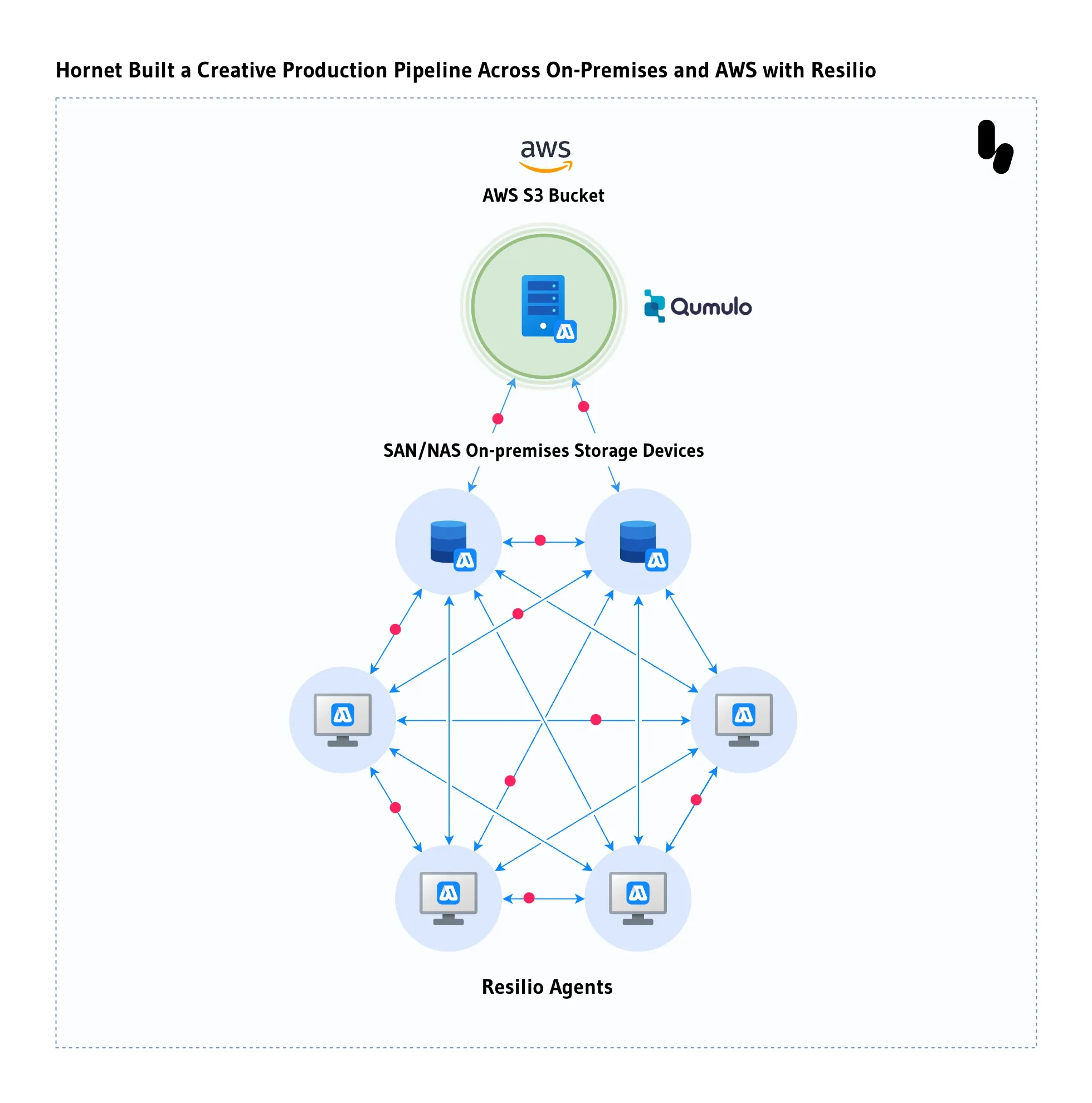
Mac Tech recommended Resilio Active Everywhere, and Hornet deployed it as the connective layer between on-premises and AWS. Resilio synchronizes selected project folders bi-directionally between Hornet's on-premises storage and a Qumulo file system in AWS backed by Amazon S3 (Simple Storage Service)—an object storage service that holds the production data in a dedicated S3 bucket, organized by project and job type. Jobs are organized by workflow, eliminating manual transfers and keeping data consistent across systems.
The Results
“Once everything was in place, the performance was night and day. File open times dropped from up to 45 minutes to two minutes, eliminating a major production bottleneck. Render nodes no longer overwhelmed origin servers, and stable file access reduced crashes and workflow interruptions.”— Gareth Porter, Head of Pipeline at Hornet
The artist's experience changed with it. Remote freelancers across the globe now work with near-local transfer speeds against AWS-hosted VDI.
Global Talent and Cost Discipline, Without the Tradeoff
For the business, a hybrid infrastructure enabled remote work, removing geographic constraints. Hornet more efficiently scales freelance teams globally, and takes on larger, more complex projects—without expanding on-premises hardware.
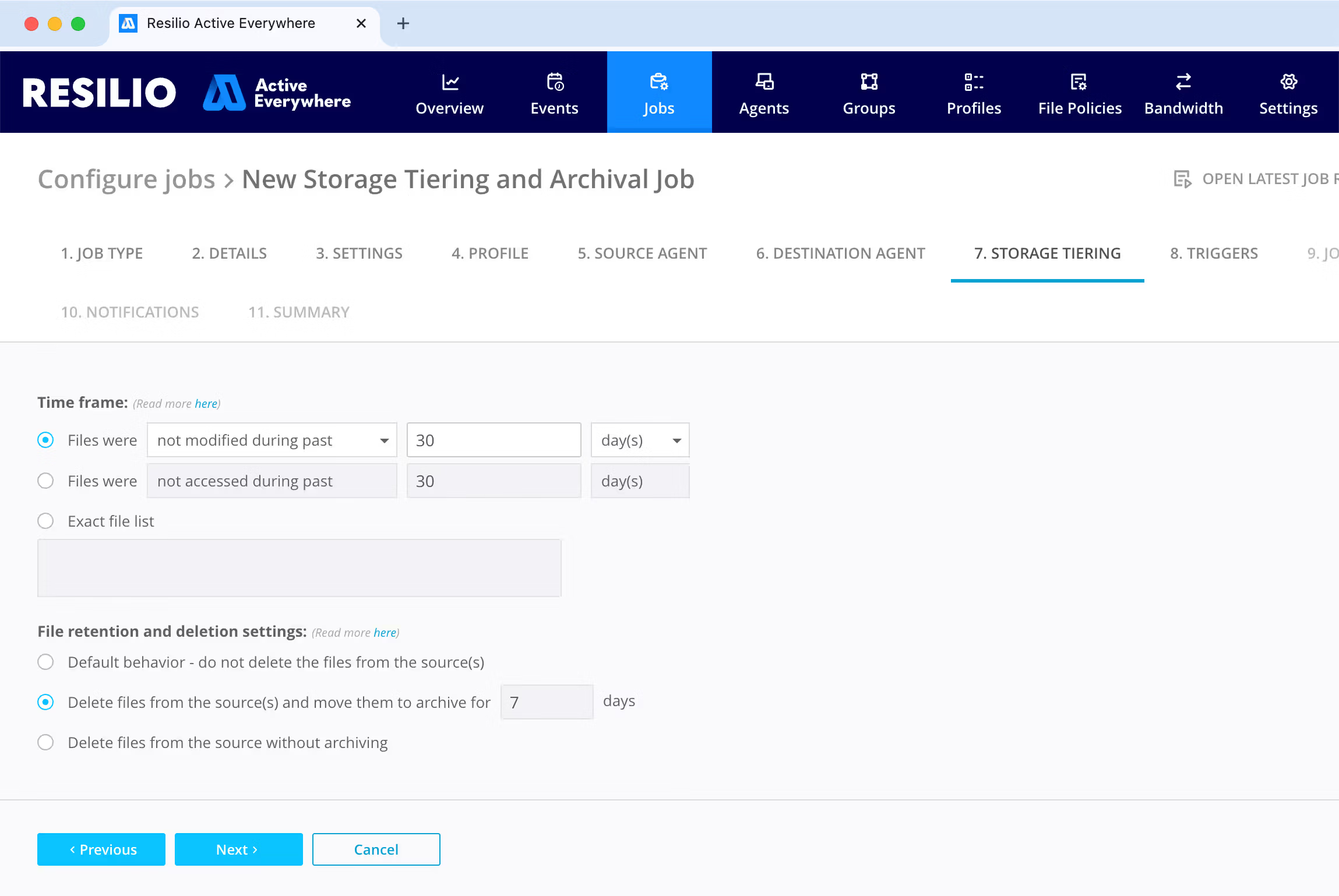
That growth happens against a backdrop of strict cloud cost discipline. AWS render resources scale up only when a project demands it. Storage is tiered across on-premises and cloud-based on access patterns. AWS accounts are segmented by function to improve security and operational hygiene. Resilio's job in that economics story is to move only what's changed, so the sync layer doesn't undermine cost controls elsewhere in the stack.
“Resilio helps us avoid unnecessary data movement and cloud spend.”— Gareth Porter, Head of Pipeline at Hornet
Move Faster
“Hybrid [storage] isn't a compromise. If you do it right, flexibility is everything — and it becomes a real competitive advantage when you're trying to future-proof your pipeline.”— Gareth Porter, Head of Pipeline at Hornet
Customer
Industry
Product
Solution
Overview
Hornet built a hybrid creative production pipeline using Resilio to continuously synchronize production data between on-premises storage and AWS, eliminating cloud file access bottlenecks and enabling global creative teams to work at near-local performance.
Explore Resilio Active Everywhere
Featured Resources

Media & Entertainment
Keep global media teams working from the same creative assets with fast, reliable file synchronization across studios, data centers, and remote artists.

Server Sync for Modern Enterprises
Synchronize file servers across sites with high-performance data movement for existing cloud and on-premises storage.

Unlock the Power of Resilio Active Everywhere with Clutch Media
How to address various data management challenges in media and entertainment, as well as other industries requiring efficient, secure, and flexible file transfer solutions.
Get started fast
Experience unified access to files wherever they’re stored.